🏌️ Movie Life Lesson: Tin Cup — Stop Optimizing What You're Not Doing

The work doesn't care about your system. It just cares that you show up and do it.

🎬 The Scene: When You Break All Your Options

There's a moment in Tin Cup where Roy McAvoy is standing over a shot, wanting to hit his driver and go for the green.

His caddy Romeo (Cheech Marin) tells him not to do it. Play it safe. Lay up with a smaller club.

Roy refuses.

So Romeo breaks the driver over his knee.

Roy seems to relent. He reaches for a smaller club, like he's going to do the sensible thing. Then he breaks that club over his knee too.

And then, in a moment of pure stubborn rage, Roy proceeds to break every single club in his bag. Every one. Except the 7-iron.

Now he's got no choice. He plays the rest of the match with just that one club.

And you know what?
He qualifies for the U.S. Open.

The lesson isn't that the 7-iron is magic.
The lesson is that once Roy eliminated all his other options—all his excuses about which club was right for which situation—he had to stop theorizing and just play golf.

🏃 Lost in America: Ten Yards in Expensive Gear

Albert Brooks nailed this exact problem in Lost in America.

His character David decides he's going to start jogging—you know, get healthy, embrace the simple life. So he goes to a sporting goods store.

What should take five minutes turns into a full gear acquisition mission. The salesperson convinces him he needs special running shoes. And specific running shorts. And the right socks. And a moisture-wicking shirt. And a stopwatch. And a sweatband.

David walks out completely outfitted. He looks like he's training for the Olympics.

Cut to the track.

He's stretching in all his new gear. Looking the part. He gets on the track, starts running and... makes it maybe ten yards before he's gasping, walking off, done.

All that gear. All that preparation. Ten yards.

This is what most of us do. We convince ourselves that buying the equipment means we're serious. That having the right setup is basically the same as doing the work.

It's not.

David didn't need running gear. He needed to run. If he'd started running in his regular clothes and regular shoes, he would have quickly learned what he actually needed. Probably just comfortable shoes and the discipline to show up.

But he never got there.
He optimized before doing.

💡 The Core Truth: You're Optimizing a Process You Haven't Started

Here's the part nobody likes to admit:

Busy work is often just another way of wasting time.

Researching feels productive.
Setting up feels productive.
Organizing feels productive.

None of it is the work.

It's Roy breaking every club to avoid committing.
It's David buying $300 of gear and quitting in ten yards.

It's avoiding the thing that actually moves you forward.

✏️ The Hemingway Pencil Myth (And Why We Love It)

Writers adore the myth that Hemingway sharpened twenty pencils before he wrote.

Not true.

“I don't think I ever owned 20 pencils at one time,”
— Hemingway, The Paris Review

But we keep the myth alive because ritual is comforting.
Ritual is easy.
Writing is hard.

The real “ritual” Hemingway followed was simple:
Same place. Same time. Every day. Sit down. Write. No ceremony needed.

📚 Real Stories About Tools Not Mattering

Ray Bradbury wrote his short stories on a rented typewriter at UCLA that he had to feed coins into—ten cents for thirty minutes. He didn't have time to optimize his process. The clock was literally ticking. So he wrote.

Thelma Schoonmaker edited Raging Bull on a Moviola—a machine from the 1920s. She won an Oscar. The tool didn't matter. Her skill and work mattered.

Steve Jobs and Bill Gates had to pay for computer time in the early days. They coded only as long as they could afford. They didn't wait for perfect conditions. They worked within their constraints.

Shakespeare wrote with a quill and ink.
Hemingway had a typewriter.
The great tennis players of the '70s used wooden rackets.

It’s not the tool that makes the artist.
It’s the work.
Consistent work at your craft, your project, your business.
That’s what gets it done.

⭐ Star Wars: Use the Force

There's a moment early in Star Wars that cuts right to the heart of this lesson.

Luke is debating with Han about blasters versus lightsabers—the tool. The gear.

Obi-Wan stops him cold.

It’s not about the blaster.
It’s not even about the lightsaber—“an elegant weapon for a more civilized age.”

It’s about mastery and control of the Force.
Which is to say: control over himself.

The most powerful “tool” in the galaxy isn’t a weapon.
It’s discipline. Presence. Focus.

The same is true for us.
The most powerful tool isn't the software or the equipment.
It’s the part only you can bring: showing up and doing the work.

🔍 How This Shows Up Today (Maybe in You)

  • The writer researching apps instead of writing.

  • The entrepreneur perfecting a logo instead of talking to customers.

  • The fitness person watching workouts instead of sweating.

  • The photographer debating gear instead of taking photos.

You're not optimizing a real process.
You're optimizing the idea of a process.

Meanwhile, professionals are already doing the work.

💔 When Getting Ready Becomes Your Identity

This is where optimization becomes dangerous.

At some point, "preparing" becomes who you are.

You're not a writer—you're someone endlessly preparing to write.
You're not a runner—you're someone with running gear who ran ten yards once.
You're not an entrepreneur—you're someone polishing a brand that hasn't launched.

The preparation becomes the shield.

Because if you never start, you never risk finding out whether you're any good.

I've watched businesses die without ever releasing a thing.
Meanwhile, competitors ship something messy, learn, iterate, and win.

Execution always beats optimization.

✅ What to Do Instead

1. Start with what you already have.
Open whatever writing software you already own. Put down 500 words. Do that for 30 days before you even think about switching tools.

2. Start before you're ready.
Talk to customers before your site is perfect. Launch before your branding is beautiful.

3. Improve only after real friction.
Not invented friction.
Not imagined friction.

Do → hit a wall → improve → repeat.

🏁 The Bottom Line

Roy McAvoy broke every club except his 7-iron.
David Howard bought every piece of gear and ran ten yards.

One did the work.
One optimized the fantasy of work.

You already know which one you're acting like.

Stop cycling through tools you haven't used.
Stop ritualizing the prep stage.
Grab your 7-iron and play the course.

The work doesn't care about your system. It just cares that you show up and do it.
📺 TV Life Lesson: The Wire - "The Bigger The Lie, The More They Believe."

In the Information Age, You Are Your Own Fact-Checker

The Wire's Warning About Dying Journalism

Season 5 of The Wire showed us exactly what happens when newsrooms become infested with hacktivists posing as journalists. Hacktivists: "politically motivated hacking" that in journalism means manipulating information to serve an ideological agenda rather than revealing truth.

David Simon wasn't just depicting Baltimore's Sun newspaper collapsing under budget cuts. He was showing us newsrooms where ideology trumps truth, where reporters manufacture stories to fit predetermined narratives.

Scott Templeton, the lying reporter who fabricates quotes and sources, represents what happens when newsrooms prioritize pushing an agenda over revealing facts. The scary part? Templeton gets promoted while honest reporters like Gus Haynes get pushed out.

Sound familiar?

The problem isn't budget constraints forcing poor journalism. The problem is newsrooms filled with people who don't trust their readers to make up their own minds from unbiased facts. So they manipulate us instead. They masquerade as having journalistic integrity when in fact their headlines and articles show their willingness to compromise ethics and truth to push an agenda. That's hackery at its most pure.

🔥 The Pattern of Manipulation: Real Headlines, Real Deception

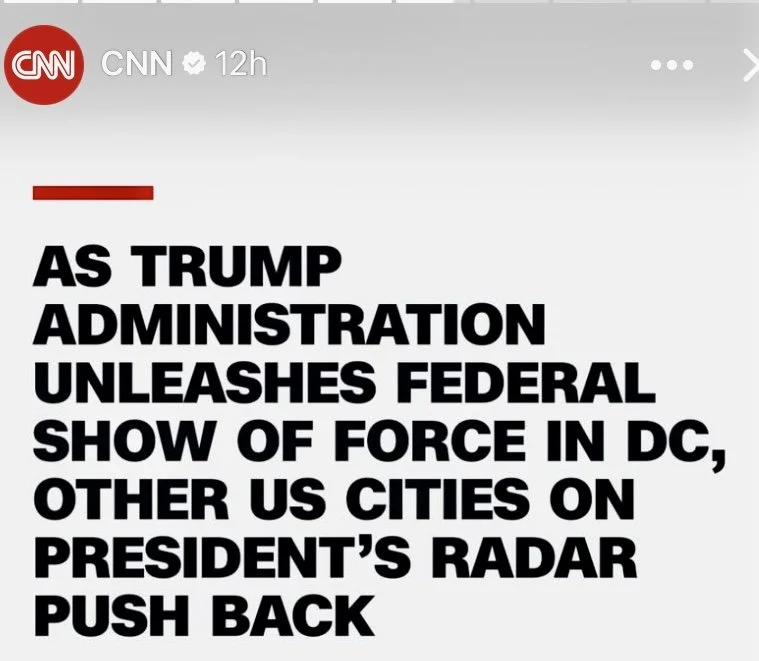
Recent headline from CNN

Which calls to mind this recent headline I saw on CNN.com:

"AS TRUMP ADMINISTRATION UNLEASHES FEDERAL SHOW OF FORCE IN DC, OTHER US CITIES ON PRESIDENT'S RADAR PUSH BACK"

I really hate that supposed news organizations run headlines like this. I learned not to do this as a fricking intern at Variety 30 years ago. And it's not like Variety was a bastion of integrity in journalism—and yet they knew the basic principles of informative writing (who what when where how) and stuck to it.

Here's what's wrong with this in one sentence: Cities don't push back. People do.

But this is just the tip of the iceberg. They do this every single day with surgical precision:

The Passive Voice Shell Game: When Objects Act on Their Own

Recent New York Times Headline:

What's Wrong: The headline makes it sound like the knife stabbed these people on its own. Who wielded the weapon? You don't find out until later in the article—if at all. This isn't journalism; it's deliberate obfuscation designed to hide inconvenient details about the perpetrator.

COVID Lab Origins: The "Scientists Say" Shell Game

Early 2020 Headlines:

  • New York Times: "New Coronavirus Is 'Clearly Not a Lab Leak,' Scientists Say"

  • NPR: "There was 'virtually no chance' that the coronavirus was released from a laboratory in China"

  • Washington Post: Originally described lab-leak theory as "debunked" and a "conspiracy theory"

What They Hid: Which scientists? The same ones getting funding from the agencies that funded the Wuhan lab? The Post later quietly "rewrote the article's headline, softening 'conspiracy theory' to 'fringe theory'" when the evidence became impossible to ignore.

BLM Riots: The "Mostly Peaceful" Masterclass

The Most Infamous Example:

  • CNN: "FIERY BUT MOSTLY PEACEFUL PROTESTS AFTER POLICE SHOOTING" —while their reporter stood in front of burning cars and buildings

Other Classics:

  • MSNBC: Ali Velshi insisted he was seeing "mostly a protest" that "is not, generally speaking, unruly" despite standing "literally in front of a burning building"

  • NBC Oakland: "Group Breaks Off of Mostly Peaceful Protest, Vandalizes Police Station, Sets Courthouse on Fire"

  • Wisconsin State Journal: "Third night of looting follows third night of mostly peaceful protest"

  • BBC: "27 police officers injured during largely peaceful anti-racism protests in London"

The Reality They Hid: The protests cost $1-2 billion in property damage in just the first two weeks, with over 30 people killed and 14,000 arrested in three months. More than 9% of protest locations experienced violence, but they called this "miniscule."

California Wildfires: The "Climate Change" Catch-All

The Vague Attribution Game: Headlines routinely blame "climate change" for wildfires without specifying:

  • What part of the climate changed?

  • How much it changed?

  • By what mechanism this caused the specific fire?

  • Why ignore poor forest management by politicians like Gavin Newsom, PG&E power lines, or arson cases?

The Pattern: Use the vaguest possible cause (climate change) to avoid investigating the specific, actionable causes (mismanagement, negligence, criminal activity).

📰 Back to the Future: From Yellow Journalism to Click Journalism

This isn't the first time American journalism has gone off the rails.

In the 1890s, William Randolph Hearst and Joseph Pulitzer pioneered "yellow journalism"—sensationalized, exaggerated stories designed to sell newspapers. Sound familiar? They literally started the Spanish-American War with fabricated stories about the USS Maine explosion. Hearst allegedly told his illustrator in Cuba: "You furnish the pictures, I'll furnish the war."

But here's what changed everything: circulation mattered because readers paid for newspapers. When people stopped buying your paper, you went out of business. This created a natural check on complete fabrication—go too far, lose too many readers, die.

The Great Transformation: Clicks Over Credibility

The internet broke that model. Newspapers no longer need paying subscribers—they need clicks for ad revenue. This fundamentally changed the incentive structure:

  • Old model: Keep readers satisfied enough to pay monthly subscriptions

  • New model: Generate enough outrage/engagement to drive clicks from anyone

The result? Headlines optimized for maximum emotional reaction, not maximum accuracy. Stories designed to confirm biases, not challenge assumptions. Truth became secondary to traffic.

Why This Makes Everything Worse

When your success depends on clicks rather than credibility, you optimize for:

  • Outrage over accuracy (angry people click more)

  • Confirmation bias over challenge (people share what confirms their beliefs)

  • Speed over verification (first to publish gets the clicks)

  • Sensationalism over nuance (simple stories get more shares)

This is why we get "FIERY BUT MOSTLY PEACEFUL" headlines. They're not trying to inform you—they're trying to get you to click, share, and argue. The engagement metrics don't distinguish between "this is helpful information" and "this makes me furious."

⚠️ Why This Matters More Than You Think

This isn't hackery. It's deliberate manipulation by people who believe you're too stupid to handle the truth.

These aren't journalists—they're ideological activists with press passes. They don't trust you to make up your own mind from unbiased facts, so they pre-package the "correct" interpretation for you.

When it happens once or twice, you could blame individual reporters. But when it happens every single day across multiple outlets with the same linguistic patterns? That's coordination.

I'm old enough to remember when reporters like Stephen Glass at The New Republic and Jayson Blair at The New York Times were exposed as liars, summarily fired, and left in disgrace. They certainly didn't win Pulitzers. Now the liars get promoted and the truth-tellers get pushed out.

The difference between Hearst's yellow journalism and today's click journalism? Hearst was trying to sell newspapers. These people are trying to sell ideology.

💰 The Real Cost of Media Lies

Hollywood takes $20-50 and wastes 2-3 hours of your life with a bad movie. These media lies take 20-50% of your income and can rob you of 2-3 years of your life.

What else would you call pandemic lockdowns that destroyed small businesses while big corporations thrived? What about mask mandates with zero scientific backing for cloth masks? Or vaccination mandates that didn't prevent transmission? How about electing someone like Zohran Mamdani as NYC mayor who wants city-owned grocery stores, $30 minimum wage by 2030, and has pledged to arrest Israeli Prime Minister Netanyahu if he visits New York?

Imagine how much headline massaging CNN will do covering that administration.

🎯 The Lesson: Become Your Own Authentication System

In the so-called "information age," we've all been forced to become our own fact-checkers because media no longer serves readers—it exploits them to serve a cultural and political ideology.

Why Newsrooms Became Propaganda Mills:

  • Incestuous relationships between journalists and the institutions they're supposed to investigate

  • Revolving door careers where reporters become government officials and vice versa

  • Collective groupthink worse than any Hollywood committee

  • Ideological bias that treats half the country as enemies who can't be trusted with unfiltered information

  • Click-driven revenue models that reward outrage over accuracy

  • Political uniformity where the overwhelming number of journalists at these organizations share the same political beliefs and vote for the same candidates from the same political party. But even that's not enough—they will not, cannot allow any dissent. Look at what happened to Bari Weiss when she went to write for the New York Times.

The Wire's Solution: Follow the Money

Remember what Lester Freamon taught us: "Follow the money."

Who funds this news organization? Where do these reporters go when they leave journalism? What story does this headline want me to believe? What story is it trying to hide? What gets them more clicks—truth or outrage?

🚨 Your BS Detector Survival Kit

The lies start with seemingly small obfuscations—exactly like that CNN headline. This requires all of us to have our BS detectors fully charged and operational.

Red Flags to Watch For:

  • Passive voice: "11 People Injured in Stabbing" vs. "Man Stabs 11 People"

  • Vague subjects: "Cities push back" vs. "Mayor Adams pushes back"

  • Loaded language: "Show of force" vs. "Law enforcement"

  • Missing context: What aren't they telling you?

  • Click-bait headlines: Designed for shares, not accuracy

  • Objects acting alone: When weapons, cars, or buildings mysteriously cause harm without human agency

Questions Every Headline Should Answer:

  • WHO specifically is doing what?

  • WHAT exactly happened?

  • WHEN did this occur?

  • WHERE is the evidence?

  • HOW do we verify this?

If a headline doesn't answer these basics, it's not journalism—it's manipulation.

🎬 The Wire's Ultimate Warning

Scott Templeton gets away with his lies because his editors want to believe them. They share his ideology. The same thing is happening in every major newsroom today.

Real journalists like Gus Haynes—the ones who care about truth over narrative—get pushed out. The ideological activists get promoted because they're useful to the machine.

David Simon showed us this wasn't sustainable. Newspapers would die, cities would collapse, and truth would become whatever those in power needed it to be.

Look around. He was right.

As I wrote in my Book Life Lessons: Finding Your Chimney, institutions reveal their deepest truths during moments of crisis. Journalism is no different.

⚡ The Bottom Line: Trust, But Verify Everything

Organizations that regularly engage in headline manipulation don't deserve to be called news organizations. They shouldn't win Pulitzers. They shouldn't enjoy press protections meant for legitimate journalists.

They're not informing you—they're programming you.

Your job isn't to be a passive consumer of information anymore. Your job is to question everything. Verify sources. Follow the money.

Because if you don't authenticate the information yourself, someone else will authenticate it for you—and they probably don't have your best interests at heart.

The Wire taught us that institutions rot from the inside when ideology replaces integrity. American journalism has come full circle—from Hearst's yellow journalism to today's click journalism. The only difference? Now they're not just trying to sell papers. They're trying to sell you a worldview.

📚Book Life Lessons: Finding Your Chimney: What World War Z Teaches About Meaningful Work

In Max Brooks's World War Z, Arthur Sinclair Jr.—former Director of the U.S. Department of Strategic Resources—recounts meeting exactly this person on a ferry from Portland to Seattle during post-war reconstruction. The man had worked in the licensing department for an advertising agency, specifically procuring rights to classic rock songs for television commercials. Now he was a chimney sweep. Given that most homes in Seattle had lost their central heat and winters were longer and colder, he was seldom idle.

When describing his new work, the man said with genuine pride: "I help keep my neighbors warm."

But Sinclair heard this transformation everywhere during the rebuilding: "You see those shoes? I made them." "That sweater? That's my sheep's wool." "Like the corn? My garden!" These weren't just career changes—they were people discovering work that connected directly to human survival and flourishing.

As Sinclair reflects: "That was the upshot of a more localized system. It gave people the

Read More

👎 CBS has officially fired Stephen Colbert.

👎 CBS has officially fired Stephen Colbert.

The Late Show, once one of the most valuable time slots in television history, is done. No replacement. No reboot. No rebranding. CBS is walking away from late night altogether. Not with a bang, but with a shrug. That's not a programming note—that's an obituary. An institution just died.

If you've ever seen HBO's The Late Shift, you know the backstory. After Johnny Carson stepped down from The Tonight Show, there was a war—Leno vs. Letterman. A behind-the-scenes bloodbath that consumed NBC and ultimately pushed David Letterman to CBS. That war is what launched The Late Show. It was CBS's entry into the late night arena, their effort to plant a flag and go head-to-head with an American institution.

Read More